The 5-Minute Freelancer Q&A #22 — Kayli Barth
In this regular feature, Story Board asks Canadian writers to share a few details about their work habits and their strategies for navigating the ups and downs of freelance life.

Kayli Barth is a Montreal-based freelance content marketing consultant who does a little bit of everything — from social media management to blog writing to digital marketing strategy. Last winter she decided to take full advantage of the freelance lifestyle: she gave up her apartment and moved to southeast Asia for four months. Earlier this month, as she was settling back into life in Montreal, she took the time to speak with Story Board about mentorship, working abroad, and her personal blog about freelancing.
What does a typical day of work look like for you?
Oh there’s no typical day for me! I do have a few regular clients that I’ve been working with for a long time. So if they have campaigns coming up or new product launches, program launches, whatever their business is, I work with them to develop the marketing and communications strategy for it. Some days I’m creating graphics for their Twitter or Instagram accounts and some days I’m writing blog content. Some days I’m writing an opt-in piece and designing a PDF guide. So there’s a really big variety. Email newsletters, sales copy sometimes. Creating landing pages.
So you’ve found diversifying your skills has been good for your freelance career?
Read the rest of this post »
Off The Wire: News for the Canadian media freelancer July 20-27
Once a week, we gather stories about the media business, journalism, writing, publishing, and freelancing—with a Canadian focus—and share them in Off the Wire. Who needs a water cooler?
From Canada:
- Broken Pencil celebrates two decades of ‘zining [Canadian Magazines]
- The Syrup Trap brings its humour to print [Masthead]
- Wrongful dismissal suit by The Tyee EIC has been settled [Canadian Magazines]
- The Sad Story of Canadian Geographic [Canadaland]
- CBC urged to find new funding models [Globe and Mail]
From The U.S. and beyond:
- In public memo, Gawker founder advocates for a more humane company [Poynter]
- The ‘9 to 5’ job is going extinct [Christian Science Monitor]
- Inside the conflicted mind of a freelancer [The Freelancer]
- How to handle a time crunch [Freelancers Union]
- Citing “an inflection point in global media,” Pearson sells the Financial Times to Nikkei [Nieman Lab]
- Why Research Will Make or Break Any Journalist’s Career [The Freelancer]
- Taylor Swift makes concessions on photography contract [Poynter]
- NPAA helps revise Taylor Swift credential agreement [NPAA]
Last week on Story Board:
- Newspapers reject overreaching freelance photography contracts: Freelance photographers have something to celebrate this week: a little pushback from newspapers against overreaching contracts for concert photography…
- 7 Must-Have Social Media Tools for Freelance Writers: In my column on growing your freelance business in 2015, one of my “must-haves” for you this year was a beefed-up social media presence. So… how’s that going for you? Here are some of my favourite social media tools to help you on your way…
Spot a story you think we should include in next week’s Off the Wire? Email the link to editor@thestoryboard.ca or tweet us at @storyboard_ca.
Newspapers reject overreaching freelance photography contracts
by Rachel Sanders
Freelance photographers have something to celebrate this week: a little pushback from newspapers against overreaching contracts for concert photography.
The Montreal Gazette, La Presse, Le Journal de Montréal, Le Devoir and Métro refused to send photographers to the Taylor Swift show at the Bell Centre in Montreal last Tuesday because of a contract that claims worldwide rights, in perpetuity, over all published photographs from the concert without offering any compensation to the photographer. The contract also gave Swift’s management the right to confiscate or destroy equipment containing photographs of the concert.
Montreal paper Le Soleil refused to sign a similar contract offered by the Foo Fighters earlier this month. Le Soleil published a post explaining the decision and explaining that they paid Québec cartoonist Francis Desharnais to draw an illustration to run with their coverage of the concert instead.
Washington City Paper took the same position on the Foo Fighters’ photography contract this month. The paper explained in a detailed post on July 2nd why they would not agree to to the terms of the Foo Fighters’ photography contract, describing the contract as “exploitation of photographers, pure and simple.”
Earlier this week the paper published another post explaining what they did instead, which was to pay two fans for photographs taken from the audience. Editor Steve Cavendish urged the band to take another look at their photography contract, saying “demanding the work of creatives for free isn’t very rock ’n’ roll.”
Amber Bracken, the president of the News Photographers Association of Canada (NPAC) says she is pleased to see media organizations taking a stand on copyright-grabbing contracts for photographers.
“NPAC is mandated to defend photographers’ rights so it’s great to see we have allies on this issue,” she told Story Board via email this week.
Bracken said that despite Canadian laws that protect creators as automatic copyright holders, photographers are seeing more and more onerous contracts that leave them without usage rights for their images.
“Contracts for concerts have been increasingly tightening for a long time but photographers and media organizations have been hesitant to react. Being meek has only gotten us backed into a corner so this push back is long overdue. I hope it continues to build momentum so we can have some meaningful dialogue around copyright, usage rights and sustainable practices,” she said.
Bracken says it’s especially frustrating for photographers to be presented with overreaching contracts by musicians and other artists.
“It’s a climate that doesn’t make sense to me, since as creators I think musicians and photographers have lots of common ground. I would hope that we can build on that to create industry standard practices that are mutually beneficial,” she said.
7 Must-Have Social Media Tools for Freelance Writers
by Miranda Miller
In my column on growing your freelance business in 2015, one of my “must-haves” for you this year was a beefed-up social media presence. So… how’s that going for you?
Here are some of my favourite social media tools to help you on your way. See, we only have so many hours in the week (15 or 20 too few, usually), but we have an incredible selection of tools online to help automate some processes and simplify others. In fact, there are so many social media marketing tools out there that it’s tough to decide which ones might benefit you most.
Your time is worth money (remember?) and these tools can help you save time and put out more compelling, engaging social content. Give these a shot:
1. Buffer App
Buffer helps you schedule your own content, but also curate and schedule relevant content from around the web. The app makes content suggestions you can just click to add and enables you to simply add any updates to your schedule from any social sharing buttons you see on content online.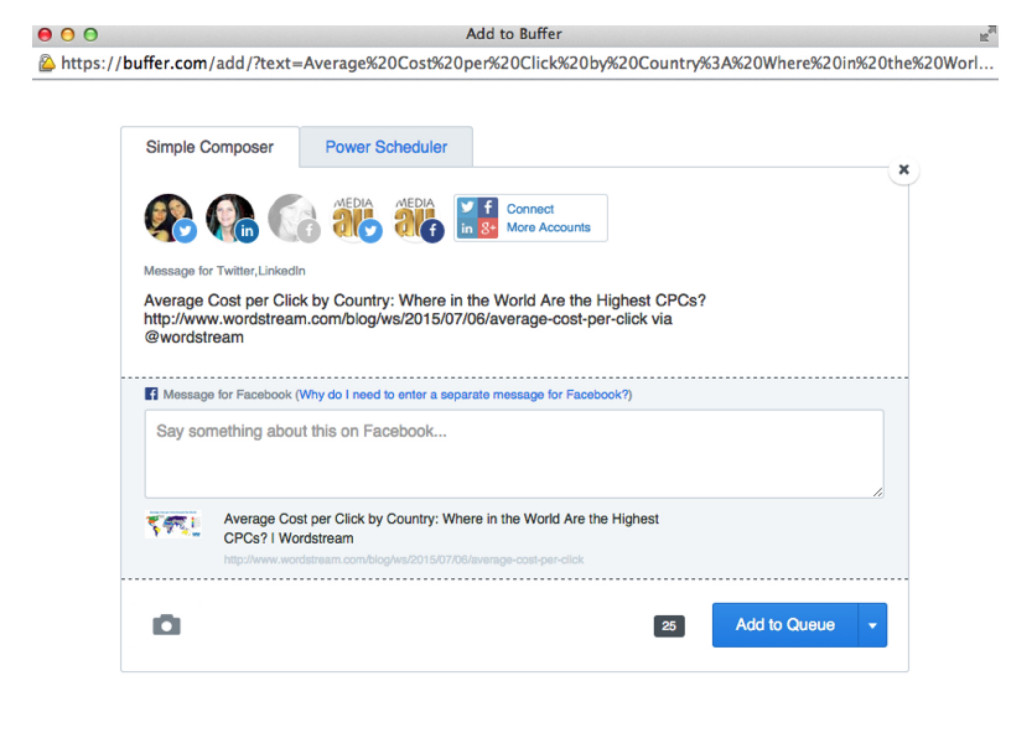 As you load links into your Buffer App, it schedules content to post to your Twitter, Facebook, LinkedIn or other connected accounts. You can always review and reschedule content:
Read the rest of this post »
Off The Wire: News for the Canadian media freelancer July 7-13
Once a week, we gather stories about the media business, journalism, writing, publishing, and freelancing—with a Canadian focus—and share them in Off the Wire. Who needs a water cooler?
From Canada:
- Memo: newsroom culture at the Globe [J-Source]
- CanLit’s $100,000 controversy: Canadian writers and publishers react [The Province]
- Bad blood: The Taylor Swift photography contract [Montreal Gazette]
- Postmedia reports major drop in revenues, Conrad Black scolds leaders [Globe and Mail]
- Pulitzer-winning journalist Paul Watson quits Toronto Star over ‘refusal to publish’ story on Franklin expedition [National Post]
- The Freelance Life with Maryam Siddiqi and Aaron Broverman [J-Source]
- Maple Leafs blogger’s tax-loss case highlights difficulties of independence [Globe and Mail]
- Peter Mansbridge drops support for Mother Canada project [CBC]
- Journalists Are Banned from Stephen Harper’s Events and It’s Stupid Nonsense [Vice]
- Obituary: Jocelyn Laurence brought out the best in writers [Globe and Mail]
From The U.S. and beyond:
- Ira Glass has acquired ownership of all of ‘This American Life’ [Robert Feder]
- So, You Want To Be a Freelancer. [The Toast]
- Why we’re not photographing the Foo Fighters [Washington City Paper]
- Byline sees a new wave in crowdfunded journalism [Journalism.co.uk]
- Freelance journalists using crowdfunding to launch investigative news project [STV News]
- Top 5 Freelance Pet Peeves [Freelancers Union]
- App for journalists: Yallo, for recorded phone calls [Journalism.co.uk]
- How I Turbocharged My Freelance Writing Productivity [Write to Done]
- When journalists take a vacation, do they actually take a break? [Poynter]
- How can crowdfunding support media business models? [The Media Briefing]
- As podcasts grow, the freelance economy takes shape [Nieman Lab]
- 5 qualities of a solopreneur [Freelancers Union]
Last week on Story Board:
- From research to story: Advice for writers: At the recent Canadian Science Writers Association Meeting in Saskatoon, Saskatchewan, two gurus of science journalism, Tom Hayden and Peter Calamai shared their sage advice on the art of turning research into a story…
Spot a story you think we should include in next week’s Off the Wire? Email the link to editor@thestoryboard.ca or tweet us at @storyboard_ca.
From research to story: advice for writers
by Lesley Evans Ogden
At the recent Canadian Science Writers Association Meeting in Saskatoon, Saskatchewan, two gurus of science journalism, Tom Hayden and Peter Calamai shared their sage advice on the art of turning research into a story. While their advice was given to and intended for science writers, many of their tips will be useful and germane to nonfiction writing generally, so I thought I would share it here.
Peter Calamai’s 10 maxims:
- There are no subjects that good communications can’t make interesting and intelligible to a thinking audience.
Granted, says Calamai, there are tricky subjects like chemistry and math that are more difficult to turn into interesting stories. “They are harder to pick,” says Calamai, “but you just have to pick ‘em.”
- Know as much as possible about the intended audience for your writing. Have a clear picture in your mind of who you are addressing, if possible an actual individual.
- Never underestimate the intelligence of your thinking reader. They are not ignorant, simply uninformed.
Good writing makes your reader feel smart, adds Hayden.
- Never overestimate your reader’s interest in a particular subject matter.
Off The Wire: News for the Canadian media freelancer June 30-July 6
Once a week, we gather stories about the media business, journalism, writing, publishing, and freelancing—with a Canadian focus—and share them in Off the Wire. Who needs a water cooler?
From Canada:
- Canada’s creative industries can lead the economic charge [Globe and Mail]
- Jesse Brown on Canadaland’s Globe and Mail report [J-Source]
- On newsroom sexism and the Canadaland report [J-Source]
- Women editors are fleeing the Globe and Mail [Canadaland]
- On independent media and social change [J-Source]
From The U.S. and beyond:
- Online search tips every journalist should know [Journalism.co.uk]
- Writers, editors at Salon move to unionize [Poynter]
- Salon Media Editorial Staff to Unionize With Writers Guild of America [The Wrap]
- 6 things to do after your pitch [Freelancers Union]
- Ask a Freelancer: Can I Afford to Go on Vacation? [The Freelancer]
- What’s unique about freelancing in Canada? [Freelancers Union]
- Freelancing: is there a way back to full-time employment? [The Guardian]
- Get your first pitches right: Tips for student journalists [Journalism.co.uk]
- Extra Credit: How to build credit as a freelancer [Freelancers Union]
- In an Uber World, Fortune Favors the Freelancer [New York Times]
Last week on Story Board:
- How do freelancers take vacations?: I’ve been wondering: how do other freelancers take vacations? I checked in with some friends and colleagues this week to gather some intel and advice on how to organize vacation time as a freelancer…
- The Born Freelancer Talks With Stuart Ross: Toronto-born, Cobourg, Ontario-based freelancer Stuart Ross inspires many not just by what he says (in his various workshops and classes) or what he creates (in his various published works since the mid-1970s) but also by just being true to himself…
Spot a story you think we should include in next week’s Off the Wire? Email the link to editor@thestoryboard.ca or tweet us at @storyboard_ca.
How do freelancers take vacations?
by Rachel Sanders
 I’m writing this from a patio beside a cabin on one of British Columbia’s beautiful Gulf Islands. Hummingbirds are hovering around a feeder close by. There’s a cold beer by my elbow. And I’m working. On my vacation.
I’m not complaining. I like my work. And I really like to be able to combine a little work with a lot of holiday — to keep projects moving but still be able to laze on a patio during the hot summer months. To me, that’s one of the great joys of being a freelancer.
But working holidays aren’t for everyone. So I’ve been wondering: how do other freelancers take vacations? I checked in with some friends and colleagues this week to gather some intel and advice on how to organize vacation time as a freelancer.
First of all, there’s the issue of simply being able to schedule time away without leaving regular clients in the lurch. Toronto writer and editor Jaclyn Law says the key is giving plenty of notice:
“I don’t have an annual holiday ritual, but when I do take time off, I try to give clients as much as two months’ notice, especially the ones that rely on me every month or every other month for a recurring project. That’s probably my best tip – no surprises for the client. If they need suggestions for someone to fill in, I provide a few names with contact info for other freelancers.”
Other freelancers, such as Vancouver comedy reviewer and podcaster Guy MacPherson, are more relaxed about scheduling holidays:
Read the rest of this post »
The Born Freelancer Talks With Stuart Ross
This series of posts by the Born Freelancer shares personal experiences and thoughts on issues relevant to freelancers. Have something to add to the conversation? Your input is welcome in the comments.
 Toronto-born, Cobourg, Ontario-based freelancer Stuart Ross inspires many not just by what he says (in his various workshops and classes) or what he creates (in his various published works since the mid-1970s) but also by just being true to himself.
What I find especially inspiring is that he is a freelancer whose activities and endeavors are almost impossible to pigeonhole. He appears to have always followed his creative muses wherever they have lead him – fearlessly and without any apparent regrets. All the while he has found a way to make a living doing what he loves to do best.
Poet, essayist, editor, publisher, co-founder of the Toronto Small Press Book Fair, creative coach, writer-in-residence, lyricist and teacher are just a few of the diverse outlets for his vast array of multidisciplinary skills over the past forty years.
His published works are too numerous and varied to list here. (I’m not sure a complete bibliography of all his work even exists!) His first work appeared in print when he was age 16 and he has been busy at it professionally ever since. All share Stuart’s unique perspective and wicked, often dark, sense of humour. His latest collection of poetry to be published is entitled “A Hamburger In A Gallery“. Also recently published is his collection of essays about the frequently turbulent world of writing, “Further Confessions of a Small Press Racketeer.” It has already received greatly appreciative reviews.
I recently asked Stuart how he viewed his own professional status.
Off The Wire: News for the Canadian media freelancer June 23-29
Once a week, we gather stories about the media business, journalism, writing, publishing, and freelancing—with a Canadian focus—and share them in Off the Wire. Who needs a water cooler?
From Canada:
- Memo: CBC note to employees on field harassment [J-Source]
- Freelancer takes to Twitter to expose low-paying writing jobs [Masthead]
- Event review: Pitch Perfect [PWAC]
- New ad campaign makes case for journalism [J-Source]
- New round of buyouts coming for Postmedia Network [Globe and Mail]
- The Media’s Disgusting Racism and Shameful Betrayal of Laura Robinson [Canadaland]
From The U.S. and beyond:
- 5 alternatives to journalism internships [Journalism.co.uk]
- The state of the American Freelancer in 2015 [Fast Company]
- How to Pitch a Story: 9 Insider Tips for Contacting the Right Editor [The Write Life]
- The best time of day to do everything at work [Fast Company]
- How Should You Respond to an Awful Edit? [The Freelancer]
- Quitting Your Job to Freelance Full Time? 3 Tools to Take With You [The Write Life]
- Contently Study: The State of Freelancing in 2015 [The Freelancer]
- 6 Things No One Tells You When You Start Freelancing [Freelancers Union]
- Recurring Revenue: The Key to an Awesome Freelance Writing Career [The Write Life]
- 3 ways to cope with freelance growing pains [Freelancers Union]
- Washington Post launches Talent Network to allow freelancers to pitch stories to editors [Washington Post]
Last week on Story Board:
- Independent media is the heart of a democratic society: On June 23rd, the Hamilton Independent Media Awards hosted a discussion panel at the Central Public Library in downtown Hamilton on the importance of independent media within a democratic society…
- Freelance journalist Laura Robinson’s lawsuit against John Furlong underway in BC Supreme Court: The lawsuit stems from an article that Robinson wrote in September of 2012 for Vancouver’s Georgia Straight newspaper in which several of Furlong’s former students alleged that he physically abused them when he was a teacher at Immaculata Roman Catholic Elementary School in Burns Lake, B.C., in 1969 and 1970…
Spot a story you think we should include in next week’s Off the Wire? Email the link to editor@thestoryboard.ca or tweet us at @storyboard_ca.